Terraforming Mars: Why making Mars "Earth-like" is harder than sci-fi shows
Imagine stepping outside your house on Mars. No bulky spacesuit, no overcomplicated oxygen tanks. Above you, a clear blue sky stretches endlessly, as calm and vast as the ocean. Sounds amazing, right? Picture it as it might be Earth’s condition 200 years ago, with its untouched landscapes, no pollution, and green as ever. It’s the kind of world we often wish we could go back to.
That’s the dream behind terraforming Mars: turning a cold, lifeless planet into a new Earth. But reality strikes. Terraforming Mars isn’t just “hard”, it’s extremely difficult. Difficult as in “we don’t have the technology or enough money or resources to do it yet” difficult. The red planet sitting next to us in the Solar System might have similarities to us, but under the surface (and even above it), it’s a whole new, hostile world.
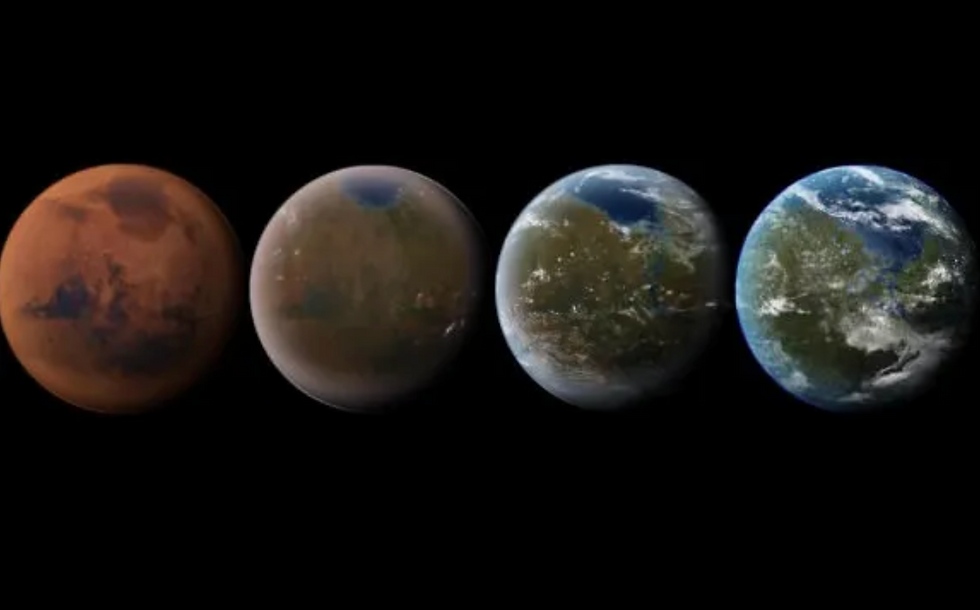
An artist’s depiction of the terraforming process of Mars (Ballard, 2006).
But seriously, why do we want to terraform Mars? Isn’t there a better option?
Human nature has always been driven by one thing: curiosity. Curiosity leads to discovery, our ambition to always look for something new, something more, and beyond us. Our beloved Earth suffers from challenges that we ourselves create, such as climate change, overpopulation, wars, resource depletion, and even potential global catastrophes like pandemics.
Mars would really be the most realistic option for a fresh start. It has a period revolution similar to Earth (24.6 hours), so humans could easily adapt (NASA, n.d.). There is also strong scientific evidence that billions of years ago, Mars was very different from the cold, dry planet we see today. NASA confirmed that rivers, lakes, and even seas once existed on Mars (NASA, n.d.). But this changed – and about three billion years ago, they all dried up. NASA also confirmed that billions of years ago, it had a thicker atmosphere and flowing liquid water (NASA, n.d.; University of Chicago, 2023). If Mars dried up a few billion years ago, would Earth’s fate be different from Mars? And if Mars were once more Earth-like, could we make it the same way again?
Before asking whether Mars can be made Earth-like again, it helps to define what "Earth-like" actually means. Planetary scientists generally point to five conditions that make Earth habitable.
First, a breathable atmosphere of roughly 78% nitrogen and 21% oxygen (NASA, 2024a) compared to Mars' thin envelope of about 95% carbon dioxide and less than 0.2% oxygen (NASA, 2024b).
Atmospheric pressure near 1 bar. Mars sits at roughly 6 hPa, less than 1% of Earth's, which is why liquid water cannot remain stable on its surface (NASA, 2024b; ESA, 2023).
Third, surface temperatures that allow liquid water. Earth averages about 15 °C while Mars averages around −63 °C (NASA, 2024b).
Fourth, the presence of liquid water itself, which is considered essential for life as we know it (NASA Astrobiology Program, 2023).
Lastly, protection from solar and cosmic radiation; Earth's global magnetic field and thick atmosphere shield the surface, but Mars lost most of its magnetic field roughly four billion years ago, leaving the surface exposed (Jakosky et al., 2018).
Terraforming Mars, in practice, means engineering each of these conditions: thickening the atmosphere, raising the temperature, introducing oxygen, and shielding the surface from radiation (McKay, Toon, & Kasting, 1991).
Opportunities of Our Terraforming Process
Terraforming Mars could bring us several major advantages. First and most obvious one, it would provide us with a second home. As Earth’s population grows and resources become more strained, expanding to another planet would put less pressure on us. It ensures that our lives can continue even if there is a major disaster happening on Earth.
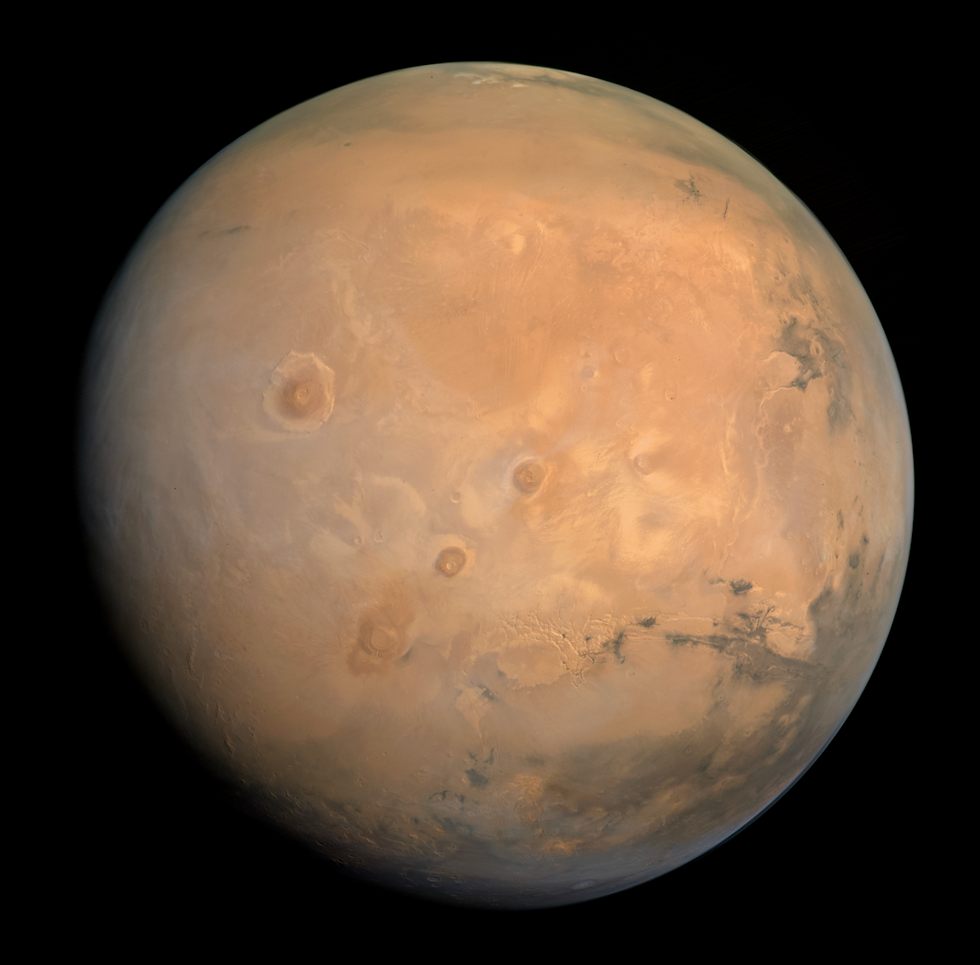
Mars in its true colour. By Kevin Gill from Los Angeles, CA, United States - Mars - August 30 2021, CC BY 2.0, https://commons.wikimedia.org/w/index.php?curid=114594182
Mars is also one of the most studied planets. It holds clues about the history of the solar system. For example, Mars lost its atmosphere and magnetic field, and thus became a cold desert. Scientists understood how it happened and therefore applied it to Earth’s own climate system. Scientific discoveries are always made through discoveries, and by terraforming Mars and living inside it, we have more opportunities to learn.
Terraforming would allow us to explore the possibility of life on Mars. In September 2025, NASA’s Perseverance rover identified a potential biosignature in a rock sample taken from an ancient riverbed in Jezero Crater. A biosignature is a chemical or structural pattern that may indicate past life, although more evidence is needed to confirm it (NASA, 2025). Because of findings like this, terraforming Mars is not just about making it habitable, but also about understanding its past.
What’s holding us back?
Despite these exciting possibilities, turning our red planet into a second Earth would be far more complicated than it sounds.
One of our biggest obstacles is the atmosphere. Compared to Earth, Mars has a very thin atmosphere, about 100 times less dense than Earth's, and is mainly composed of carbon dioxide. This means that there is absolutely no space to breathe for us.
Because of this thin atmosphere, it cannot trap heat efficiently, just like how our atmosphere shields us from the intense heat of the Sun. It is also a factor that causes its temperature to become very low. No solar radiation protection (UV light protection) means it would be dangerous to any form of life on its surface.
Luckily, scientists have proposed ideas to counter this problem. Releasing greenhouse gases and melting polar ice caps would theoretically thicken Mars’ atmosphere. However, Mars basically does not have enough carbon dioxide to create an Earth-like atmosphere to begin with. If all the available carbon dioxide trapped in the planet’s surface, ice caps, and soil were released, it would only increase the pressure to about 7% that of Earth, as shown in the diagram below (NASA, 2018).
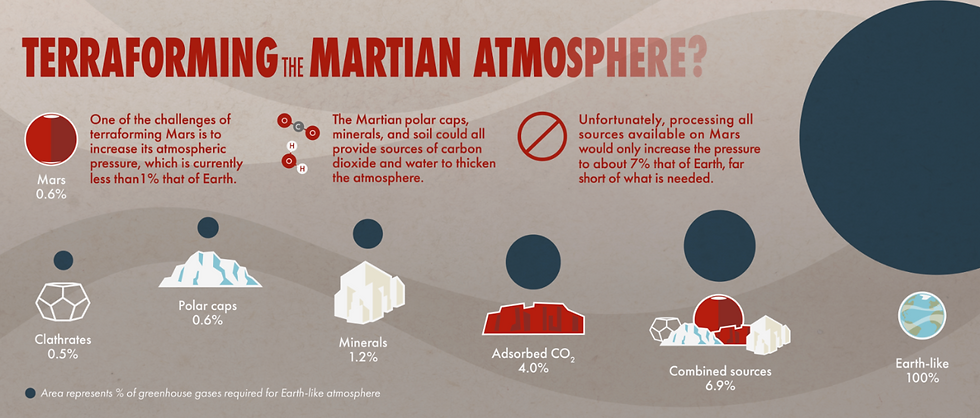
Terraforming the Martian Atmosphere? (NASA, 2018)
But Mars’ atmosphere isn’t only our issue. Another major challenge we are facing is the lack of a global magnetic field. Earth’s magnetic field – the magnetosphere – serves its primary purpose as a “protective shield”. The magnetosphere deflects solar wind and cosmic radiation, preventing the atmosphere from being stripped away (NASA, n.d.).
Mars lost its magnetosphere a billion years ago. Without Mars’ magnetic field protection, we are constantly exposed to solar wind, which strips away its atmosphere into space (NASA, n.d.). This is the real reason why Mars transformed from a warmer planet into the red, dry, arid planet we see today.
The lack of a magnetic field would also mean the surface of Mars is exposed to high levels of radiation. This means that without any sort of protection, it would be dangerous for both humans and any other living creatures to set foot on it (NASA, n.d.). Because of this, scientists have suggested extreme solutions, such as creating an artificial magnetic shield in space (NASA, n.d.). However, these ideas are still theoretical and far beyond current technological capabilities.
Let’s not forget about its freezing temperature. As I mentioned before, Mars’ thin atmosphere is unable to trap heat from the Sun. On Earth, greenhouse gases help keep the planet warm by holding in heat, but Mars lacks this ability. This is Mars’ primary reason why its temperature sits at -60°C, which is even colder than the Arctic!
Conclusion
Terraforming Mars is definitely one of the most ambitious ideas, and it would be a universal achievement to inhabit it. It provides us with a possibility of a second home, a future beyond Earth.
However, reality says otherwise. Mars’ lack of a stable atmosphere, extreme weather and temperatures and the absence of a magnetic field all show that transforming Mars into Earth-like is incredibly difficult with our current technology. This means that terraforming Mars would probably become a long-term goal of humanity rather than a near-future solution. In the end, while science fiction inspires us to imagine a green and livable Mars, real science reminds us just how challenging that dream truly is.
But even if we could do it, terraforming Mars raises a bigger question for all of us: should we do it? Personally, I think there's something uncomfortable about reshaping an entire planet just because we can. If there's even a small chance that microbial life exists on Mars, wiping it out to build a second Earth feels wrong; almost like erasing a story before we've had the chance to read it. We haven't even taken proper care of the planet we already have, so it feels strange to spend trillions of dollars trying to "fix" Mars while Earth is still struggling with climate change and inequality. At the same time, I understand the other side. If humanity stays on one planet forever, we're putting all our hopes in a single basket, and history shows that planets, including ours, don't last forever.
“The future of humanity is going to bifurcate in two directions: Either it's going to become multiplanetary, or it's going to remain confined to one planet, and eventually, there's going to be an extinction event” (Musk, 2013).
References
Arizona State University. (n.d.). Mars atmosphere. Retrieved March 26, 2026, from https://marsed.asu.edu/mep/atmosphere
Ballard, D. (2006). Mars transition (terraforming stages) [Image]. Wikimedia Commons. Retrieved March 26, 2026, from https://en.wikipedia.org/wiki/File:MarsTransitionV.jpg
Musk, E. (2013, May 29). D11 Conference interview [Video]. YouTube. Retrieved March 26, 2026, from https://www.youtube.com/watch?v=ZGK2J01_Z_U
National Aeronautics and Space Administration. (n.d.). Did Mars ever look like Earth? We asked a NASA scientist (Episode 10). Retrieved March 26, 2026, from https://www.nasa.gov/solar-system/did-mars-ever-look-like-earth-we-asked-a-nasa-scientist-episode-10/
National Aeronautics and Space Administration. (n.d.). Mars facts. Retrieved March 26, 2026, from https://science.nasa.gov/mars/facts/
National Aeronautics and Space Administration. (2018). Mars terraforming not possible using present-day technology. Retrieved March 26, 2026, from https://www.nasa.gov/news-release/mars-terraforming-not-possible-using-present-day-technology/
National Aeronautics and Space Administration. (2025). NASA says Mars rover discovered potential biosignature last year. Retrieved March 26, 2026, from https://www.nasa.gov/news-release/nasa-says-mars-rover-discovered-potential-biosignature-last-year/
University of Chicago. (2023). Why did Mars dry out? New study points to unusual answers. Retrieved March 26, 2026, from https://news.uchicago.edu/story/why-did-mars-dry-out-new-study-points-unusual-answers
NASA. (2024a). Earth fact sheet. NASA Goddard Space Flight Center. https://nssdc.gsfc.nasa.gov/planetary/factsheet/earthfact.html
NASA. (2024b). Mars fact sheet. NASA Goddard Space Flight Center. https://nssdc.gsfc.nasa.gov/planetary/factsheet/marsfact.html
European Space Agency. (2023). Mars: Facts & figures. ESA. https://www.esa.int/Science_Exploration/Space_Science/Mars_Express
NASA Astrobiology Program. (2023). The search for life: Follow the water. NASA. https://astrobiology.nasa.gov/
Jakosky, B. M., Brain, D., Chaffin, M., Curry, S., Deighan, J., Grebowsky, J., et al. (2018). Loss of the Martian atmosphere to space: Present-day loss rates determined from MAVEN observations and integrated loss through time. Icarus, 315, 146–157. https://doi.org/10.1016/j.icarus.2018.05.030
McKay, C. P., Toon, O. B., & Kasting, J. F. (1991). Making Mars habitable. Nature, 352(6335), 489–496. https://doi.org/10.1038/352489a0
Comments